Can breathing practice reduce stress?
The short answer is yes!! When we encounter a stressful situation, our bodies release cortisol, the primary stress hormone. Prolonged stress can lead to a cascade of physical and mental health issues, from anxiety to heart problems. Neuroscientist Andrew Huberman has an innovative solution that can help you regain control with the power of breathing. His 4-7-8 technique involves: Breathing in through the nose for 4 counts Holding your breath for 7 counts Breathing out through the mouth for 8 counts Repeat This technique involves extended exhalation, which helps [...]

All About ACL Injuries
Australia has the highest reported rates of anterior cruciate ligament (ACL) injury in the world, and the rate has risen 70 per cent in under 25s over the last 15 years. In males, the peak incidence in 2014–15 was for 20–24-year-olds; for females, it was for 15–19-year-olds. (Medical Journal of Australia) Whether you’ve experienced an ACL injury or want to learn more about the causes, prevention and management, this blog will outline everything you need to know. What Is an ACL The Anterior Cruciate Ligament (ACL) is the most [...]

Buying new Runners??
When we look at buying a new pair of running shoes it is not as simple as it seems. The way a shoe is built, and the cushioning of the shoe plays a role not only in absorbing the shock generated when landing on the foot, but also in how the shoe will assist in lifting the foot off the ground. Although some companies advertise otherwise, no shoe can completely ‘take away shock’ or ‘offload joints’ or allow you to be ‘injury free’. However, finding shoes that are comfortable and [...]
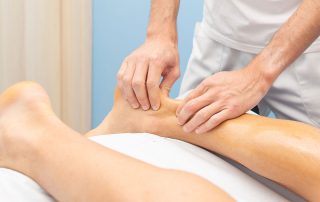
Painful Heel or Back of the Ankle? You may be suffering from Achilles Tendinopathy.
The Achilles tendon is a thick strong tendon that is formed by the two calf muscles – Gastrocnemius muscle (the large thick calf muscle) and the Soleus muscle (the smaller deeper muscle). The tendon attaches into the back of the heel bone called the calcaneus. The tendon is encased in a sheath enabling it to transmit forces to and from the foot. When running, the tendon can be subjected to loads that are three times the body weight. It is not surprising that it is considered to be the [...]

THE CORE – PART 2
HOW DO WE TRAIN IT TO “TURN ON”? When we train our core, we re-educate the timing and activation of the muscles. Timing and co-activation with other muscles within the core is called ‘core training’. At Janet Brandt-Sarif Physiotherapy, we will teach you how to find these deep muscles on yourself and to correctly activate them. You start with activating the transversus abdominus while being able to breathe properly, and then progress to activating the smaller muscles in your back (multifidus). We will work out the correct cue that works [...]

THE CORE – PART 1
– WHAT IS IT REALLY? – WHY IS IT IMPORTANT? – HOW DO WE TRAIN IT TO TURN ON? – HOW DO WE STRENGTHEN IT? WHAT IS THE “CORE”? Lots of people have the goal of having a strong stable core but what does that really mean? On the infomercials on TV, there are hundreds of machines used to “tighten” your core and give you a six pack. This can be very misleading. Here at Janet Brandt-Sarif Physiotherapy we take a deeper look at the core which is actually made [...]